RPG INSIGHTS · ISSUE 025 · 11 OCTOBER 2026
ISO 9001:2026: Turn the Release into Better Business Decisions
A revised standard creates a decision point: will the business refresh its paperwork, or improve how it prevents failure, protects customer commitments and invests in opportunity? RPG Insights examines the release through that commercial lens.
What the release changes—and what leaders should do
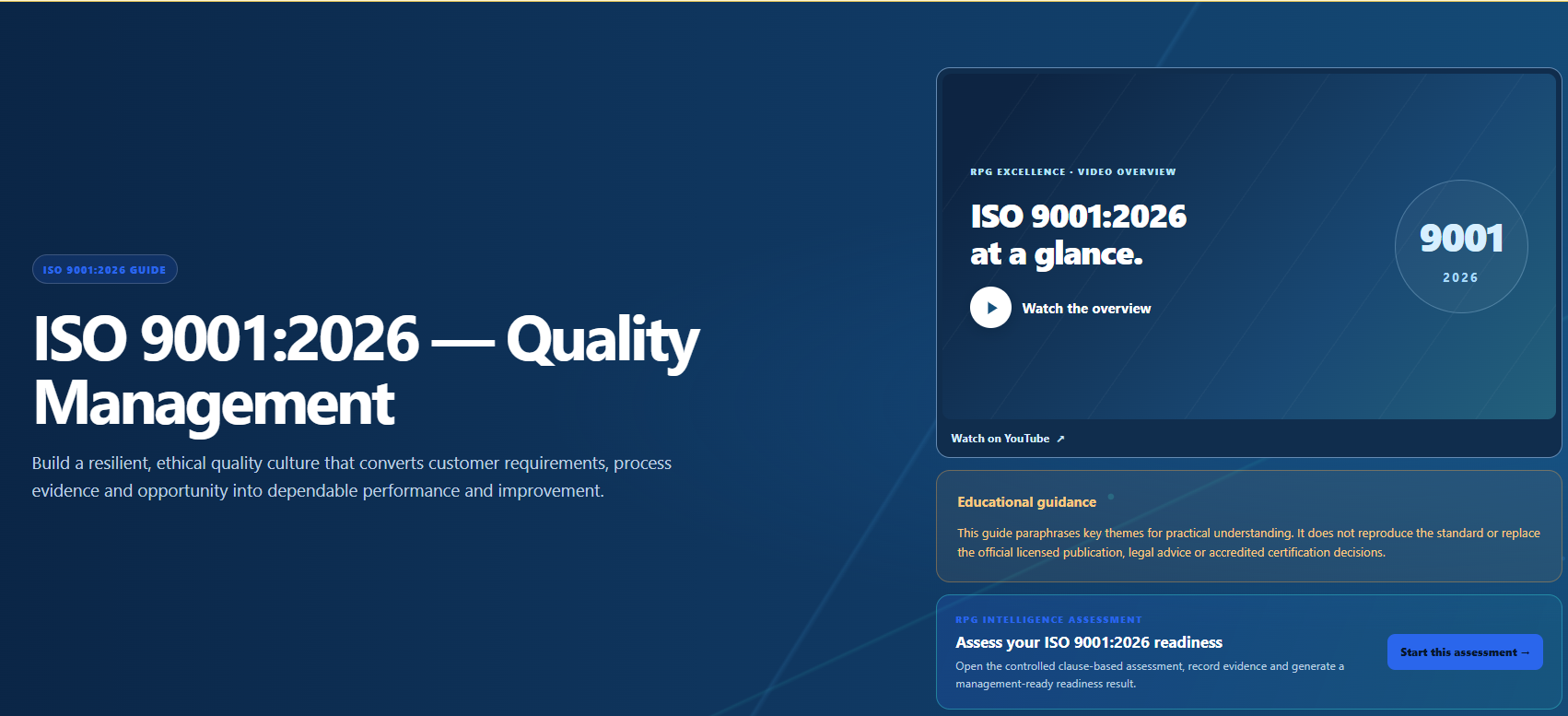
ISO published ISO 9001:2026 on 16 September 2026. Its public guidance highlights leadership, quality culture, ethical behaviour, distinct consideration of risks and opportunities, awareness and a new informative Annex A. Climate consideration carries forward from the 2024 amendment. Existing systems can be improved through targeted changes.
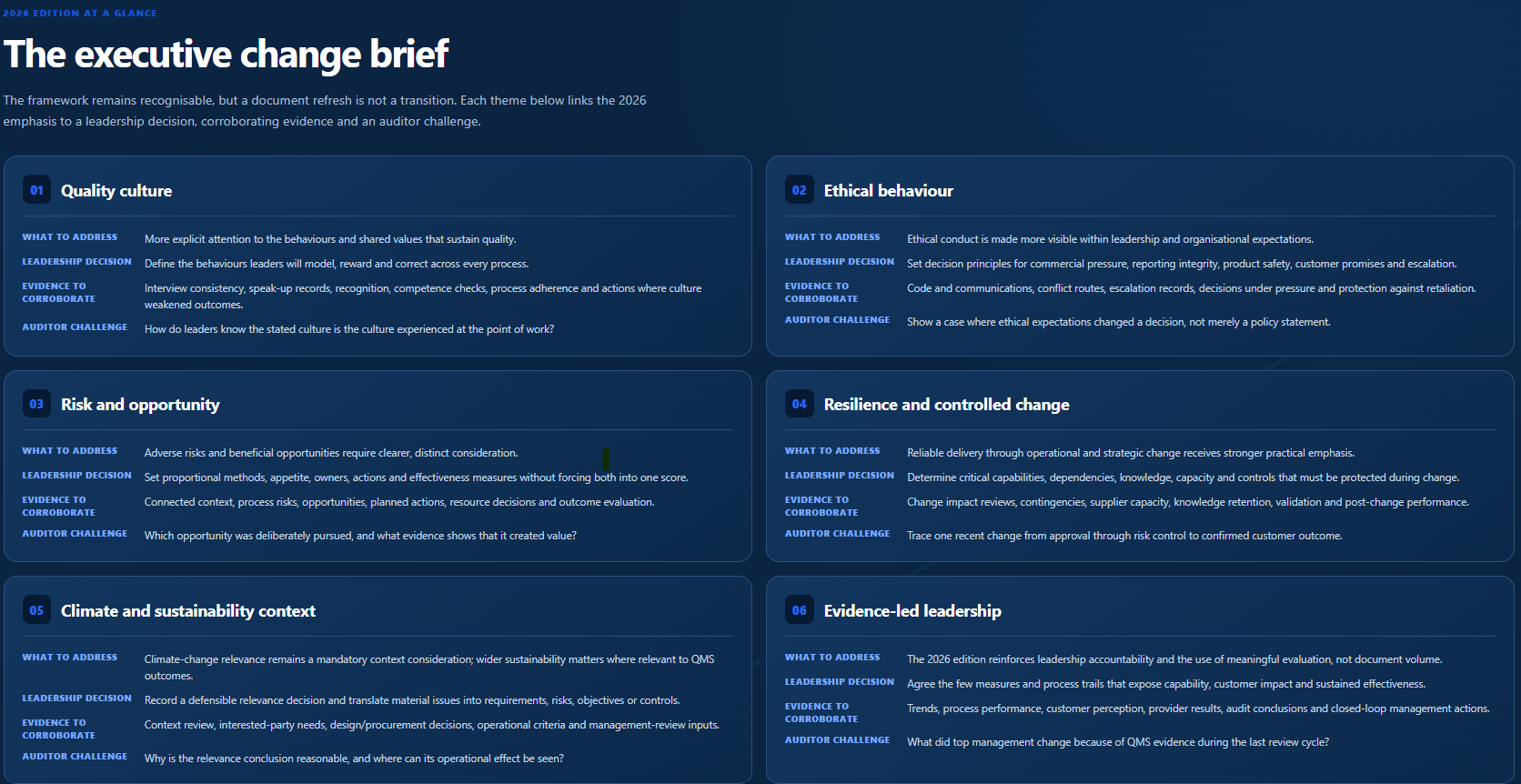
Use the licensed standard for the actual requirements. This newsletter is RPG’s implementation analysis: the six priorities below translate the release into decisions to test within your own business. They are not six new mandatory registers or a substitute for the publication.
Release sources: ISO publication announcement and ISO’s business guidance. Source check: 11 October 2026.
Quality culture
Make the expected behaviour observable. Review what happens when a delivery deadline conflicts with acceptance criteria. Can people stop work, report a concern and obtain an authorised decision?
Business value: fewer avoidable escapes and less time recovering from decisions taken under pressure.
Ethical decisions
Use a real commercial dilemma: an unsupported delivery promise, a concealed defect or an optimistic performance report. Establish who escalates, who decides and how the decision is recorded.
Business value: protect customer trust and the integrity of information used to run the business.
Risks and opportunities
Choose one exposure to reduce and one opportunity worth investing in. Give each an owner, resources and an outcome measure. Test the result rather than counting entries in a register.
Business value: direct effort towards reduced loss and justified growth.
Change and dependable delivery
For a supplier, software or capacity change, check affected requirements, competence, knowledge and process interfaces before approval. Compare actual performance after implementation with the intended result.
Business value: improve the chance that investment delivers benefits without disrupting customer commitments.
Context and climate relevance
Review whether climate-related conditions affect your products, services, suppliers or delivery capability. Record the reasoning and translate relevant issues into operating decisions. Broader sustainability topics need a clear QMS connection.
Business value: make planning reflect the conditions in which the organisation actually operates.
Evidence and leadership
Take one declining customer or process trend to management review. Record the decision, resource commitment, accountable owner and subsequent result. An attractive dashboard is useful only when it changes action.
Business value: expose recurring costs and give leaders a defensible basis for intervention.
A commercial example: the delivery promise that costs twice
Consider a fictional component supplier that accepts an accelerated order while inspection capacity is already committed. The order looks profitable; overtime, rework and a late shipment then consume the margin.
A useful transition review would trace the promise through order acceptance, capacity approval, production, inspection and release. Who understood the constraint? Who could challenge the commitment? Which decision rule failed? Was the corrective action verified on a later order?
Measure the opportunity in your own data: rework hours, premium freight, customer complaints and time spent resolving repeated issues. Any return depends on the improvements implemented and the results achieved; the revision itself does not guarantee a saving.
Executive insight: ask for a decision, an owner and a result
At the next management review, choose one customer outcome that matters commercially and follow it across process boundaries. Ask where the system is vulnerable, which evidence supports that judgement and what management will change.
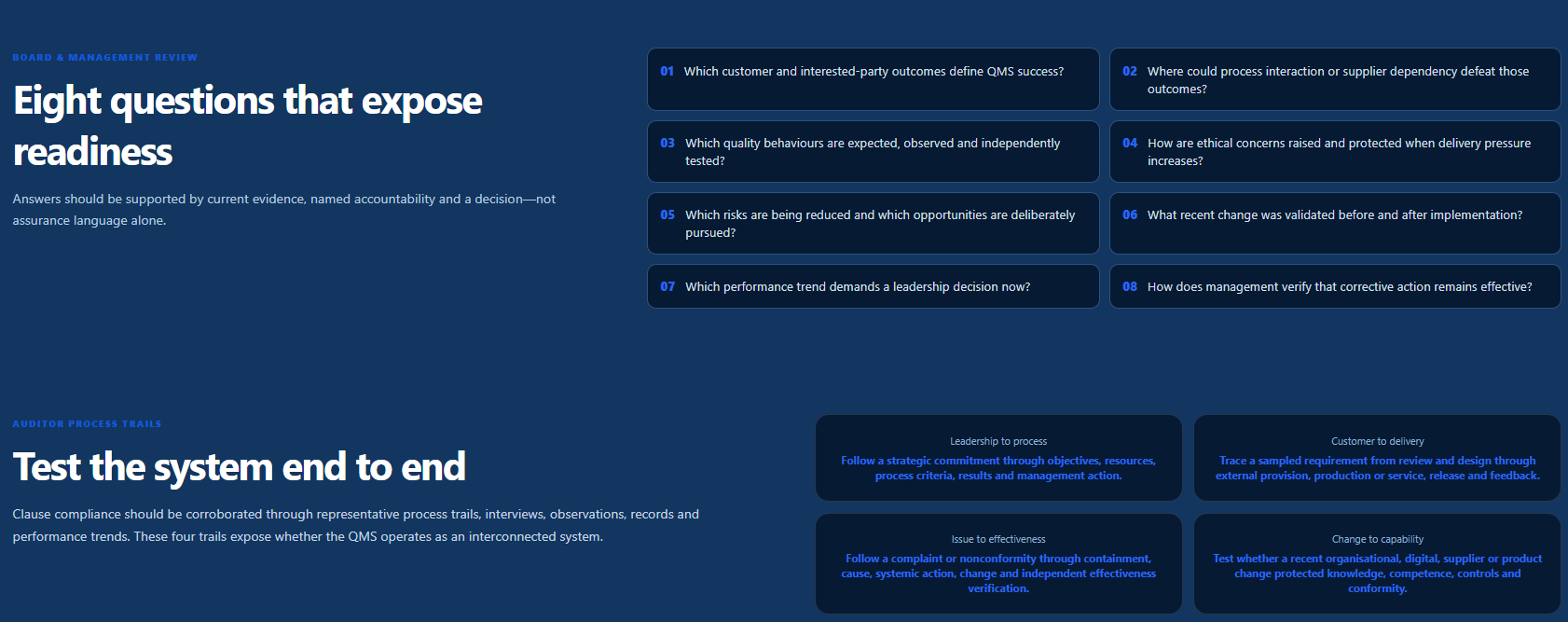
The RPG guide presents eight leadership questions and four process trails. Use them to challenge confident statements with samples: a customer requirement through delivery, a complaint through verified corrective action, or a change through demonstrated capability.
Move from clause interpretation to an assurance trail
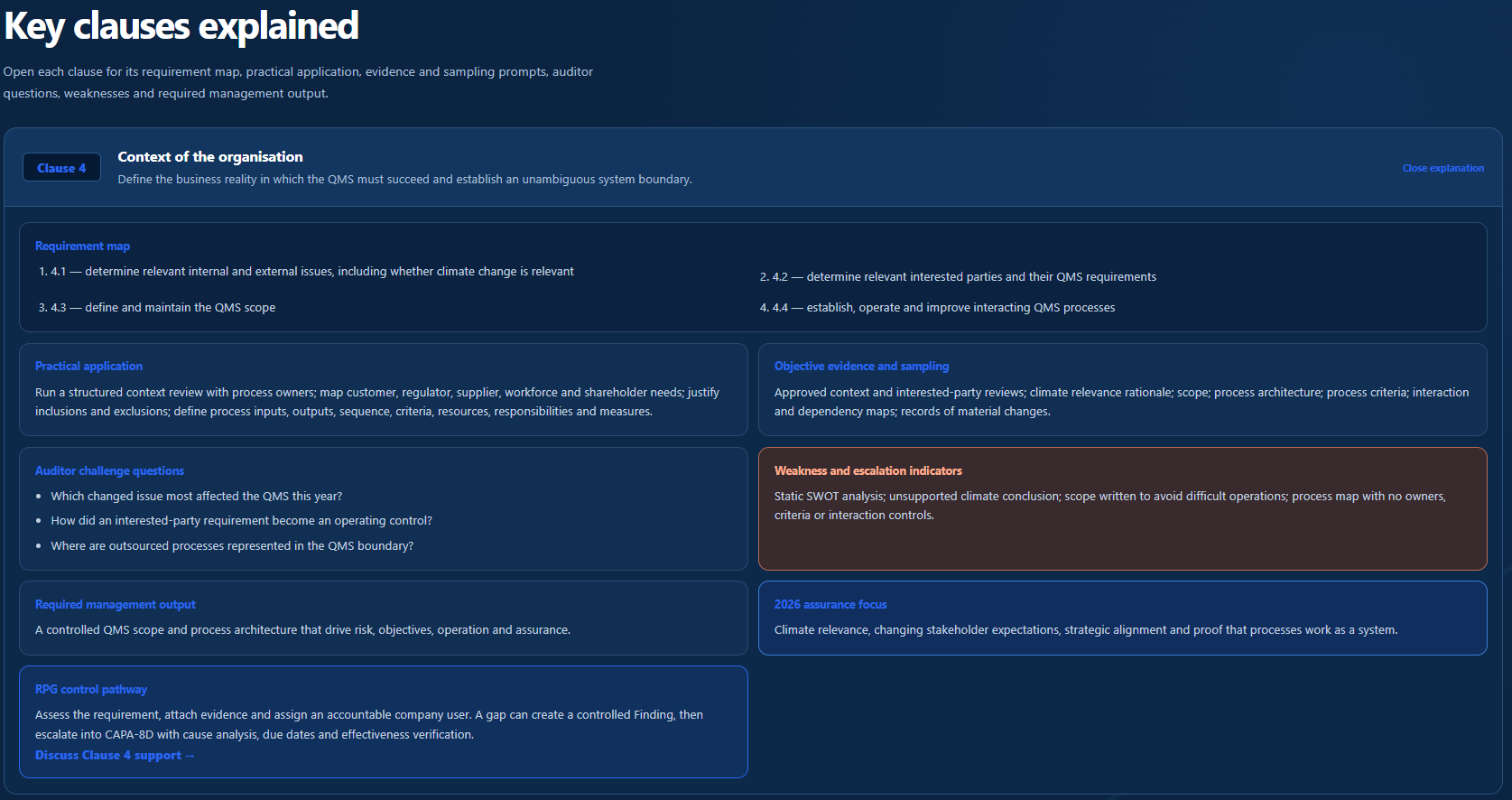
The clause explanations in the RPG guide connect intent, practical application, evidence prompts, auditor questions and management outputs. Start with a process you understand, then use the relevant clause explanations to identify what should be checked.
For example, an interested-party requirement should lead to a clear operational decision, an accountable process owner and evidence of the result. Where those links break, record the gap and decide whether a process, resource, competence or governance change is needed.
Build a reviewable trail: requirement → evidence → gap → owner → action → effectiveness check. This is an implementation method; organisations should select controls proportionate to their own circumstances.
A practical first 90 days
Use this example to sequence improvement. It is an RPG planning suggestion, not an ISO deadline; adapt it to your size, risk and certification programme.
Establish the baseline
Obtain the published standard. Brief leaders and process owners. Agree the certification route with your certification body. Sample existing evidence and prioritise gaps by customer and business impact.
Output: an approved transition scope, named owners and a prioritised gap list.Change the controls that matter
Address the highest-priority gaps. Review decision authority, opportunity evaluation and change controls. Engage affected staff and test understanding at work. Update documentation where the process review identifies a need.
Output: implemented controls with evidence of use.Test results and make decisions
Audit selected end-to-end process trails. Verify action effectiveness and competence. Review remaining gaps with leadership and agree resources, dates and the next assurance milestone.
Output: a management-reviewed readiness position supported by samples.Certification: confirm your own route
Global ACI’s transition requirements set 30 September 2029 as the end date within their stated accreditation scope. Ask your certification body to confirm the applicable arrangements, audit timing and evidence it will expect. Plan backwards from the agreed audit date.
Global ACI transition requirements, version 1.0. Check current instructions before committing to an audit schedule.
Continue exploring
RPG Excellence’s independent educational and implementation analysis. Use the official licensed standard for requirements and your certification body for certification decisions. Software and guidance do not themselves establish conformity.