A recovery plan can identify the right action and still fail if nobody knows who may authorise it. Roles, responsibilities and authorities determine whether that plan can become a timely, controlled response.
The outage that became a decision bottleneck
Consider a fictional engineering manufacturer whose critical chemical supplier delivers inconsistent batches. Production is suspended, suspect stock is quarantined and the alternative supplier needs qualification. The recovery plan exists, but the operations director is unavailable.
Purchasing can place an urgent order. Quality can assess product acceptance. Environmental specialists can review the substitution. Yet nobody can demonstrate who may approve exceptional expenditure, authorise the change or decide that the process is ready to restart. Hours pass while colleagues seek permission.
The interruption exposes a governance weakness: people have responsibilities, but their decision authority and escalation arrangements are unclear. The recovery route depends on a person rather than an agreed control.
Start with the business you actually operate
Module 4 links the responsibility-assignment record to Module 1 Site Profile and Module 3 Context Assessment. This gives ownership an operational basis: the site boundary, processes and priorities already identified in the continuity programme.
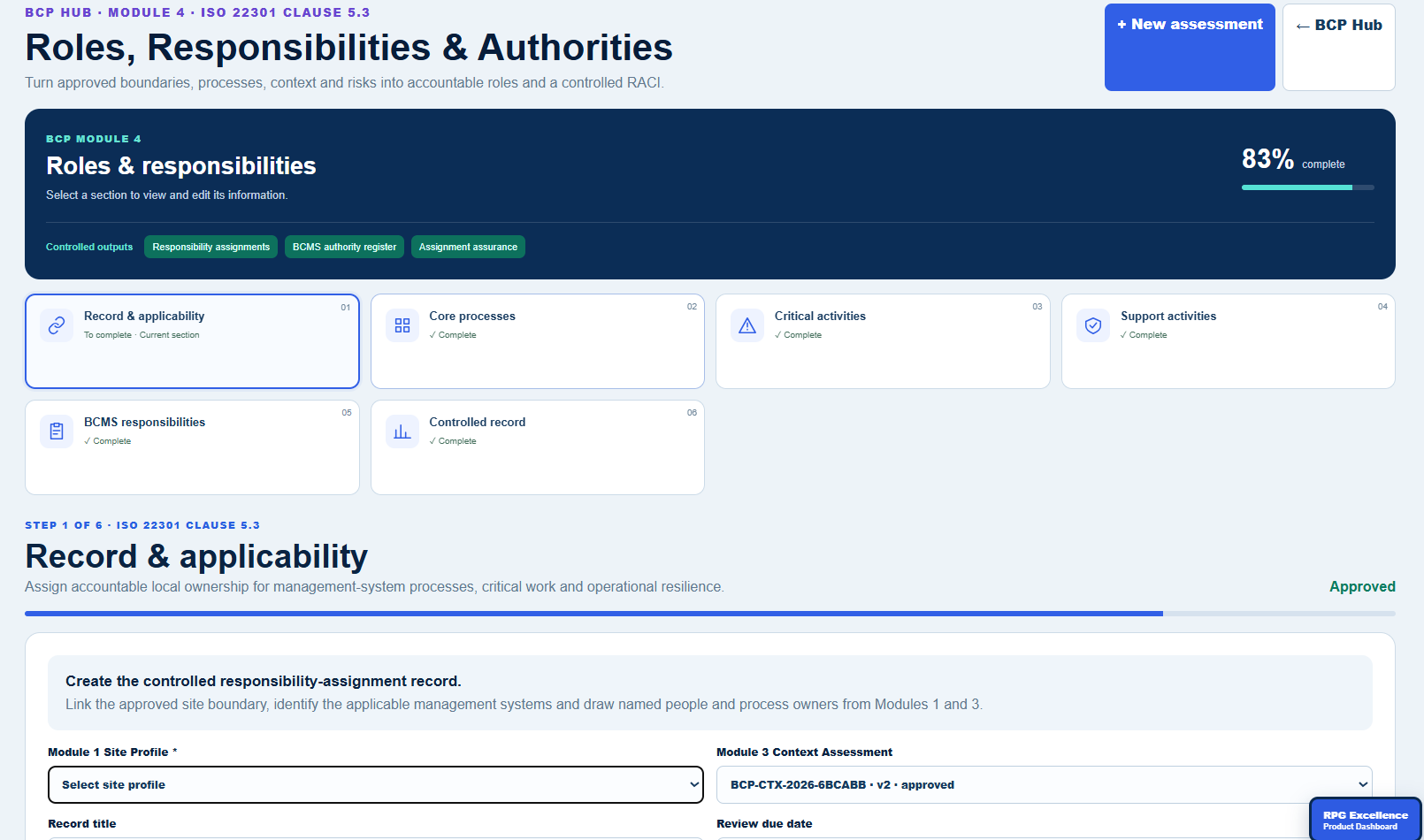
The six-stage workspace covers Record & applicability, Core processes, Critical activities, Support activities, BCMS responsibilities and Controlled record. Users can see their progress and work through the assignment record in a structured sequence.
Assign ownership to processes, not just departments
An organisation chart shows reporting lines. It does not necessarily establish who owns supplier qualification, continuity training, customer communication or recovery readiness. Those decisions often cross departmental boundaries.
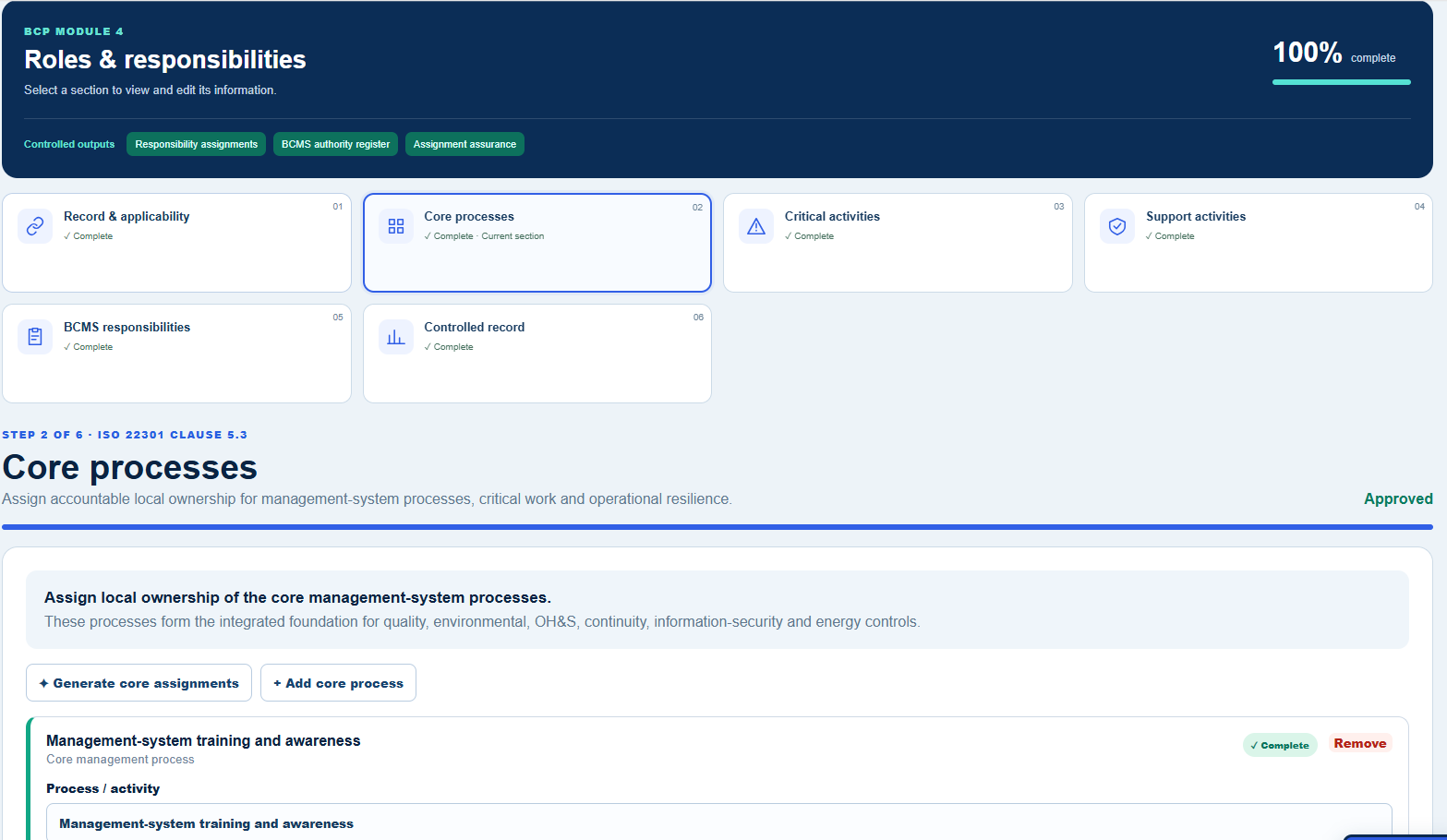
The Core processes stage supports generated assignments and additional processes. Users select the management systems applicable to each process, rather than applying every standard indiscriminately. The example shown selects quality and environmental management for training and awareness.
This allows one operational process to carry the relevant management-system responsibilities without creating separate, conflicting ownership lists. Generated assignments still need review by the people who understand the work.
Make RACI a decision aid
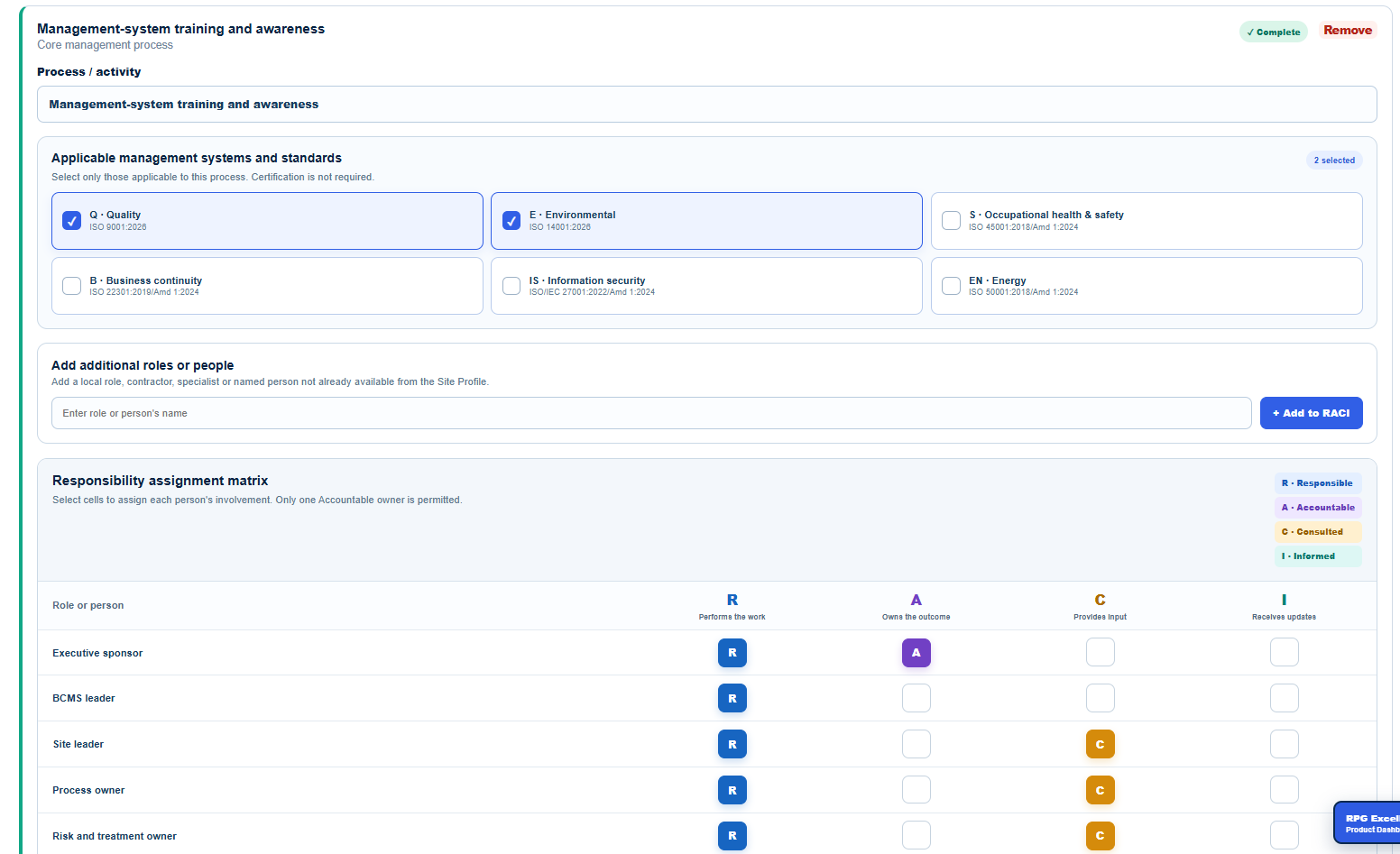
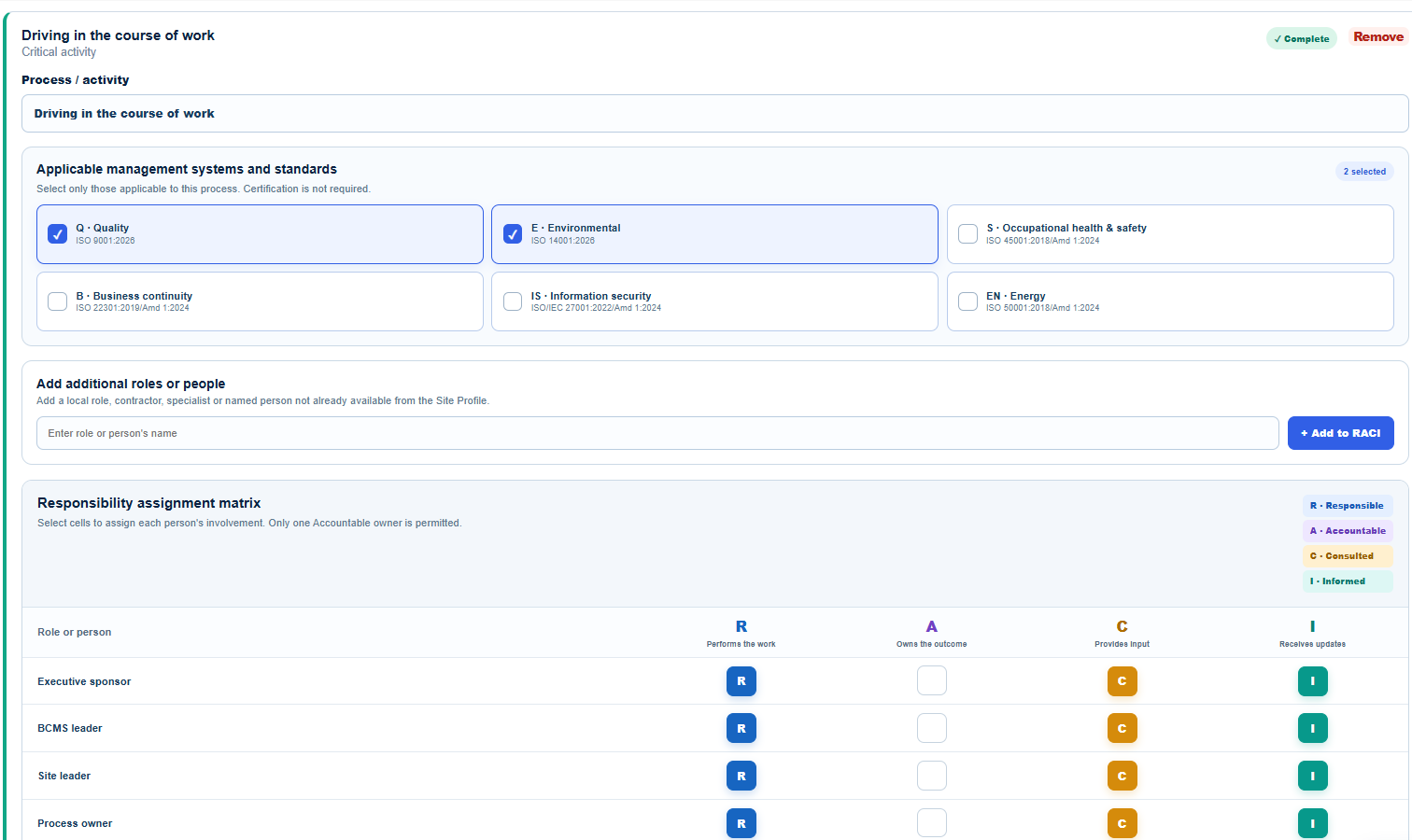
RACI distinguishes four forms of involvement: Responsible performs the work; Accountable owns the outcome; Consulted provides input; Informed receives updates. Module 4 presents these assignments through a colour-coded matrix and permits only one Accountable owner for each activity.
For the interrupted manufacturer, qualification of the replacement chemical might be carried out by a technical specialist, owned by the authorised process leader, informed by quality and environmental specialists, and communicated to production and purchasing. The organisation must choose assignments appropriate to its own authority structure.
A RACI entry does not itself grant spending authority, demonstrate competence or approve a restart. It needs to work alongside defined authority limits, operating criteria and escalation routes. The one-owner rule is an RPG workflow control; RACI is an implementation method, not a prescribed ISO template.
Include critical and support activities
Continuity depends on more than the main production process. Transport, IT access, facilities, utilities, purchasing and communication can each constrain recovery. Responsibility should therefore cover critical work and the support activities on which it relies.
Module 4 separates these activities so organisations can assign ownership and select the relevant management systems at activity level. The displayed driving-at-work example illustrates the assignment layout; applicability must be reviewed for the actual task, including occupational health and safety where relevant.
In the outage scenario, transport availability, technical access and customer updates all need owners. Leaving these interfaces unassigned can delay recovery even after replacement stock arrives.
Responsibility must come with usable authority
An accountable person needs to understand what they can decide, which limits apply and when they must escalate. The module supports authority and competence controls alongside primary holders and deputies. Its controlled outputs include responsibility assignments, a BCMS authority register and assignment assurance.
For this fictional manufacturer, the authority review should establish who can approve emergency procurement, who controls technical acceptance, who reviews environmental implications and who authorises restart. Deputies need appropriate authority and competence; adding a name alone does not establish either.
After approval, the organisation should communicate the arrangements and test them through a realistic exercise. Can the deputy act? Can the specialists be reached? Can decisions be made within the recovery window? Completion of a record is the starting point for that verification.
The commercial return is faster, better-supported decisions
Clear ownership can reduce time spent searching for permission, duplicating work and reconciling competing instructions. Defined consultation helps bring technical, customer and environmental considerations into the decision before expenditure or restart is authorised.
These are potential benefits, not guaranteed software outcomes. They depend on suitable assignments, current personnel, understood authority limits and exercised arrangements. Measure the difference through decision time, unresolved ownership gaps and exercise performance.
For audit purposes, follow a sample decision from the source process through the assigned owner, authority limit, consultation and resulting record. That is a more useful assurance trail than asking only whether a responsibility matrix exists.
Where Module 4 fits in the implementation programme
Module 1 establishes the site and process profile. Module 3 establishes organisational context and interested-party needs. Module 4 turns that foundation into responsibility and authority arrangements. These arrangements support subsequent risk assessment, business impact analysis, strategies and incident response.
The module is positioned against ISO 22301:2019 Clause 5.3. ISO 22301 provides the business continuity management-system framework; the six-stage workflow, colour-coded RACI and generated assignments are RPG implementation features. Using the module does not by itself establish conformity or certification.
- Review one critical process and identify its accountable owner.
- Confirm who performs the work, provides input and receives updates.
- Define authority limits, deputies and escalation arrangements.
- Communicate the assignments and exercise a decision under realistic constraints.
How RPG Excellence supports the control
RPG Excellence Module 4 brings source-linked process ownership, management-system applicability, a colour-coded RACI and authority controls into one structured workspace. Use it to expose ownership gaps and establish reviewable responsibility arrangements before disruption tests them.
Explore Module 4 Roles & Responsibilities →This article provides general information and does not replace a task-specific assessment, competent professional judgement or legal advice.